Materials
Waterproof Fabric for Tactical Shell Jackets and Rain Gear
Waterproof fabric prevents liquid water from passing through under pressure, and it only works as a system: the fabric carries a membrane or coating, and every seam and closure has to be sealed as well. The engineering problem is that stopping liquid water and allowing moisture vapour to escape pull in opposite directions. A waterproof garment that is sealed everywhere also traps the wearer's own sweat unless the structure provides a vapour pathway, which is why the specification has to be written around the conditions and activity level rather than around the word waterproof. Without sealed seams, a waterproof claim does not hold.
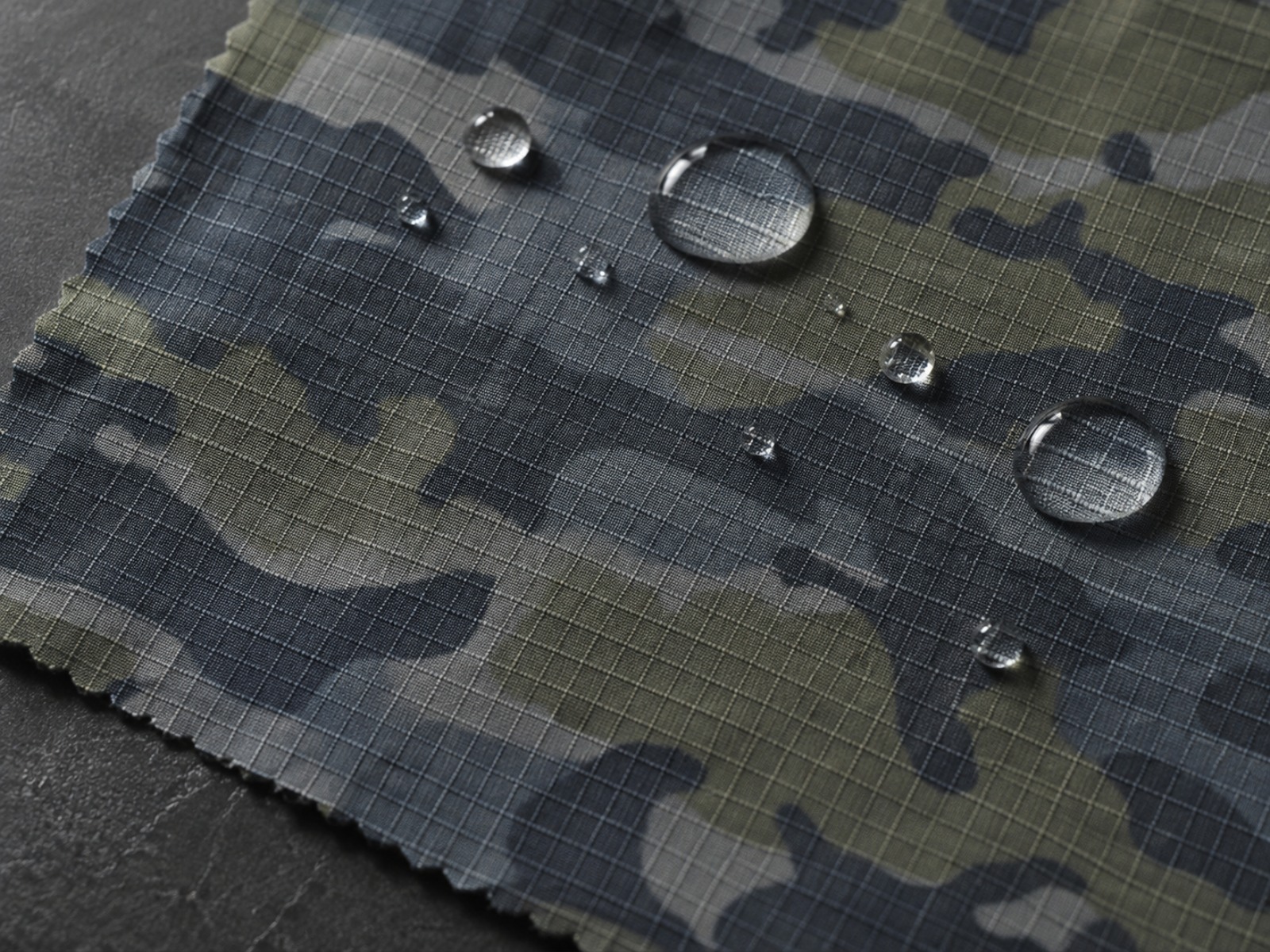
- Composition
- DATA REQUIRED
- Weight range
- DATA REQUIRED
- Best applications
- Wet Weather · Cold Weather · Tropical / Humid
Gallery
Waterproof Fabric in detail
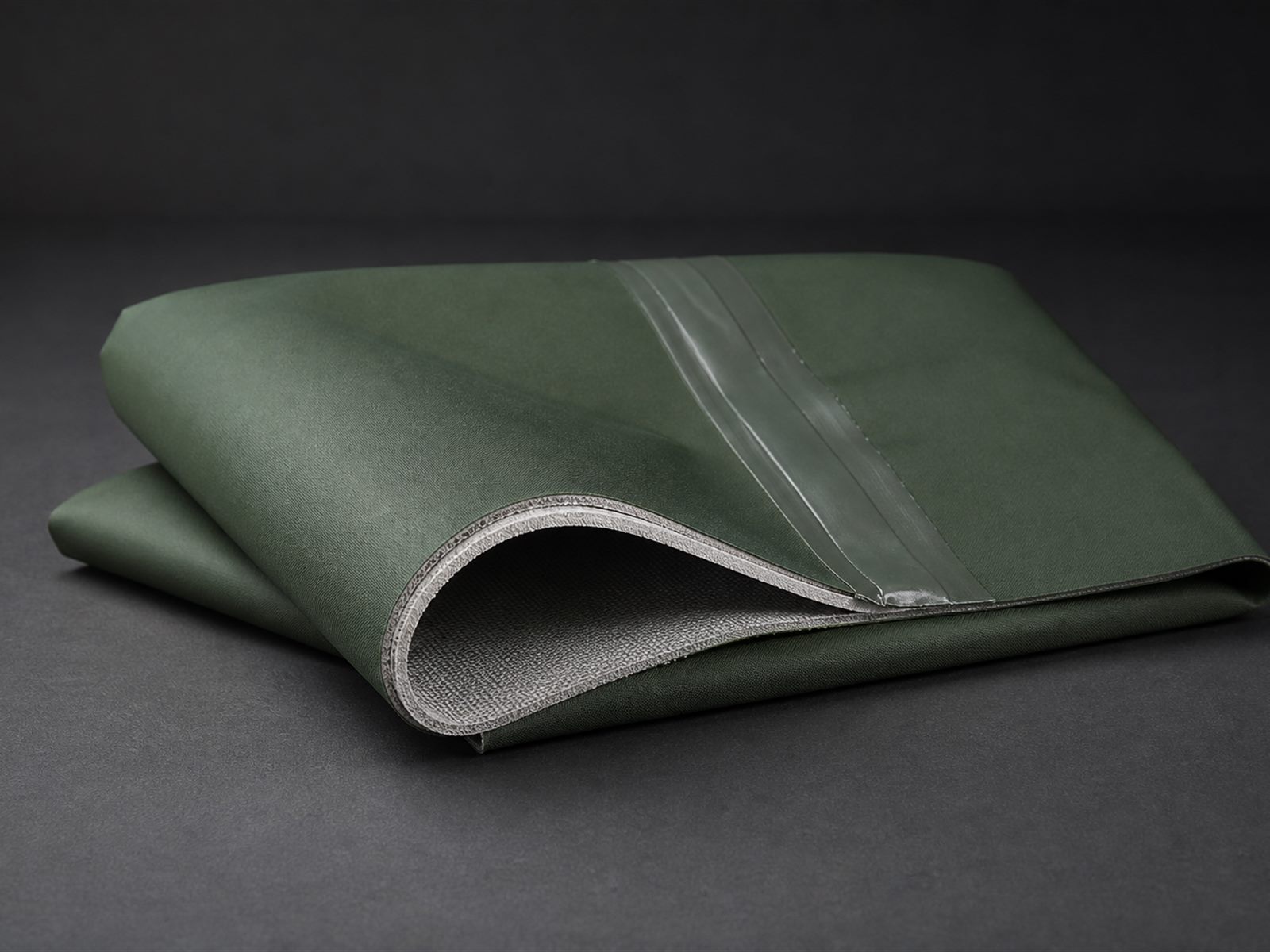
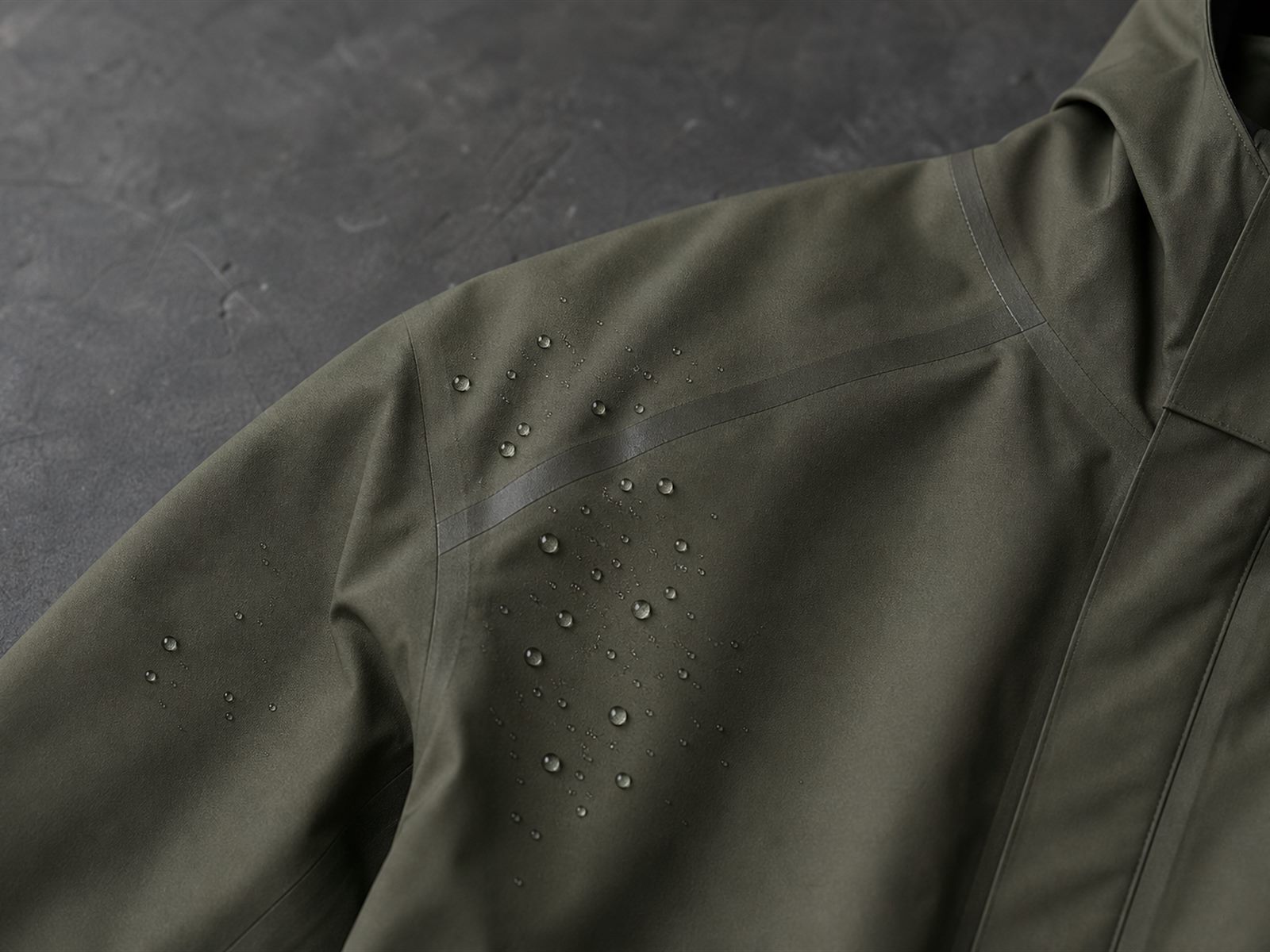
What it is
What is it?
A fabric carrying a membrane or coating that blocks liquid water while, in breathable versions, still allowing moisture vapour to pass. It is used as the outermost layer of a garment system, together with sealed seams and protected closures, since the fabric alone cannot keep water out of a garment that is stitched together.
Function
How it works
Liquid water and water vapour behave differently at small scale, and waterproof membranes exploit that difference. A microporous membrane has pores far smaller than a liquid droplet but much larger than a vapour molecule, so liquid cannot pass while vapour can. A hydrophilic coating works differently: it does not have pores but transports vapour molecule by molecule through the polymer. Both mechanisms require a difference in vapour pressure across the material, which means the wearer has to be warmer or more humid inside than outside for vapour to move. When vapour production exceeds the transport rate, moisture condenses inside the garment. That is why a waterproof shell can be both fully sealed and wet from the inside, and why venting and closure design matter as much as the membrane.
Technical data
| Composition | DATA REQUIRED — not published until confirmed |
|---|---|
| Available weight range | DATA REQUIRED — confirmed per programme |
| Best applications | Wet WeatherCold WeatherTropical / Humid |
We do not publish composition or weight figures we have not confirmed for a specific programme. Ask for the figures that apply to your product.
Advantages
Advantages
- Prevents liquid water penetration under sustained rain and under pressure from kneeling or leaning, which a repellent finish alone cannot do
- Allows a garment to be used as the outermost layer in wet weather, protecting the insulation layers beneath so the whole system keeps working
- Blocks wind completely as a side effect, which raises the effective warmth of whatever is worn underneath
- Available in breathable constructions that allow vapour transfer during moderate activity, provided the design also manages venting
- Supports a clearly stated performance specification, including the test method and acceptance level, which makes the claim verifiable rather than aspirational
- Compatible with a range of face fabrics so the shell can be specified for abrasion resistance, packability or quietness as required
Limitations
Limitations
- Wrong choice for light rain and high activity: the sealed construction limits vapour transfer, so the wearer ends up wet from condensation and would have been better served by a water resistant, air permeable jacket
- The garment is only waterproof if the seams, zips and closures are sealed to the same standard. A fabric specification without a seam and closure specification is incomplete
- Heavier, stiffer and noisier than a water resistant woven, and less comfortable in warm conditions
- Membrane laminates can delaminate, and seam tape can lift. Both are repairable only in limited ways and represent the main failure modes of the garment
- Repellent finish on the face fabric is still required; when it wears out the face wets out, the garment feels cold and vapour transfer drops even though it still does not leak
- Higher unit cost and more process control than a water resistant alternative, which is only justified where real rain and pressure exposure exist
Performance
Performance profile
The same material can be the right choice in one climate and the wrong choice in another; these are the trade-offs as they affect how Waterproof Fabric behaves in a garment.
Hot weather performance
A waterproof shell is generally the wrong garment for hot weather, because a sealed construction retains heat and limits vapour transfer. Where rain protection is unavoidable in heat, the specification should prioritise a lighter laminate and a design with mechanical venting, and the wearer should expect some condensation during exertion.
Cold weather performance
The intended role. As the outer layer of a layering system over fleece or synthetic insulation, a waterproof shell protects the insulation from rain and wet snow and blocks wind, which is what keeps the system warm. Cold-weather use also delays condensation, because the temperature gradient across the membrane favours vapour transfer.
Durability
The face fabric can be specified for high abrasion resistance, but the functional durability risk lies in the laminate and the seam tape. Flexing, packing, heat and repeated washing all stress the bond, and performance should be assessed through a representative wash and use cycle rather than on a new sample.
Drying
A waterproof shell does not absorb much water into its structure, but a laminate holds water between layers and in the face fabric, so it dries more slowly than a single-layer water resistant woven. Surface water should be shaken off and the garment hung rather than folded wet, since stored moisture affects the laminate.
Comfort
The trade-off is inherent. The garment keeps rain out and blocks wind, but it limits vapour escape, so comfort depends on activity level and on how the design manages venting through openings, chest and underarm vents, and adjustable closures. Comfort in this class of fabric is a design outcome, not a fabric property.
OEM options
OEM options for this material
The 6 points that can be specified when Waterproof Fabric is written into your programme.
- Laminate or coating construction selected for the expected rain exposure, abrasion level and packability requirement
- Seam sealing method specified alongside the fabric, since the two are one specification and both must be verified on the production sample
- Closure and opening design developed to provide venting, so the garment manages vapour rather than only blocking water
- Face fabric chosen for the required abrasion resistance and hand, using a buyer's reference garment where available
- Repellent finish and care requirements agreed, including how the finish is maintained over the garment's life
- Performance requirements stated with a defined test method on both the fabric and the finished garment, so the claim can be verified rather than assumed
Care
Care considerations
- Wash according to the buyer's care label; detergent residue and fabric softener reduce water repellency on the face fabric
- Do not store the garment wet or folded for long periods, since trapped moisture affects the laminate and the seam tape
- The care label should state how to maintain and renew the face fabric's repellency, because the shell's comfort depends on it even when its waterproofness does not
- If waterproof performance is a contractual requirement, the test method and the wash cycle it applies after should be agreed before bulk is placed
Recommended garments
Where this material is used
Products in our range where Waterproof Fabric is a realistic specification option, drawn from 4 candidate builds.
Product
Waterproof Tactical Shell
A waterproof tactical shell is a set of compromises, and a buyer should know exactly which compromises are being made.
Product
Hunting Camo Jacket
A hunting jacket is judged by two properties that pull against each other: how quietly it moves through brush, and how well it survives that brush.
Product
Tactical Field Jacket
A field jacket is bought for a specific job: it carries what the wearer needs to reach without opening a pack, stays out of the way when the wearer kneels, climbs or drives, and can be worn over a shirt or a fleece without becoming a straightjacket.
Product
Cold Weather Tactical Jacket
A cold weather jacket has to hold warmth, allow movement and get rid of moisture, and those three requirements pull against each other.
FAQ
Waterproof Fabric FAQ
How do I know a fabric is genuinely waterproof?
By the test method and the acceptance level stated in the specification, and by confirming them on the production sample, including the seals. A description in marketing language is not a specification, and the seams must meet the same standard as the fabric.
Why do I feel wet inside a waterproof jacket?
Condensation, not leakage, in most cases. Vapour transfer depends on a vapour pressure difference, and during hard exertion the body produces more moisture than the membrane can move. Venting design and activity management reduce the effect; no membrane eliminates it.
Is a waterproof shell always better than a water resistant one?
No. For light rain and high output activity, an air permeable water resistant jacket is often more comfortable and is the correct choice. A waterproof shell earns its cost in sustained rain and pressure exposure.
Can a waterproof garment be repaired if it delaminates?
Only to a limited degree, and usually not to its original performance. Delamination is a laminate failure that cannot be reversed. This is why the bond quality and the care instructions are specification items rather than secondary details.
Does washing ruin a waterproof jacket?
Not the waterproofing itself, if it is washed as instructed. Washing mainly affects the repellent finish on the face fabric, which can be restored. The greater risks are harsh mechanical action, high heat and storing the garment wet.
Related Materials
Related Applications
Related Capabilities
Related Articles
Related Categories
Request this material against your specification
Tell us the garment, the climate and the wear pattern. We will confirm what is available for your programme and state clearly which figures are confirmed and which still need data.