Skip to content
TACTICALOEM / ODM TACTICAL APPAREL
ENEnglish

Products / Hunting & Outdoor Camouflage Clothing

Custom Hunting & Outdoor Camouflage Clothing Manufacturer

Hunting and outdoor camouflage clothing is the one apparel category where being seen is a defect. That single fact changes every specification decision. Fabric is judged on how much noise it makes when a branch drags across it, how the print breaks up a human silhouette at realistic distance, and how the garment behaves when the wearer is kneeling, crawling or sitting still for hours. The costs are specific and they are not optional. Quiet fabrics are generally softer and often less abrasion-resistant than a crisp ripstop. Higher water resistance usually means a stiffer, noisier surface. Heavier insulation adds warmth but reduces packability, which matters when the garment has to be carried rather than worn. Visibility is a further tension in markets where safety requirements apply, and the usual answer is a reversible or partially high-visibility construction with an agreed trade-off between concealment and being seen. This page covers shell and lining choice, hood and collar design, closure and pocket layout, quiet construction methods, seat and knee reinforcement, print and colour control, size development, private label, sampling and bulk production.

custom hunting clothingcamouflage hunting apparel OEMwholesale hunting camo clothinghunting apparel supplier
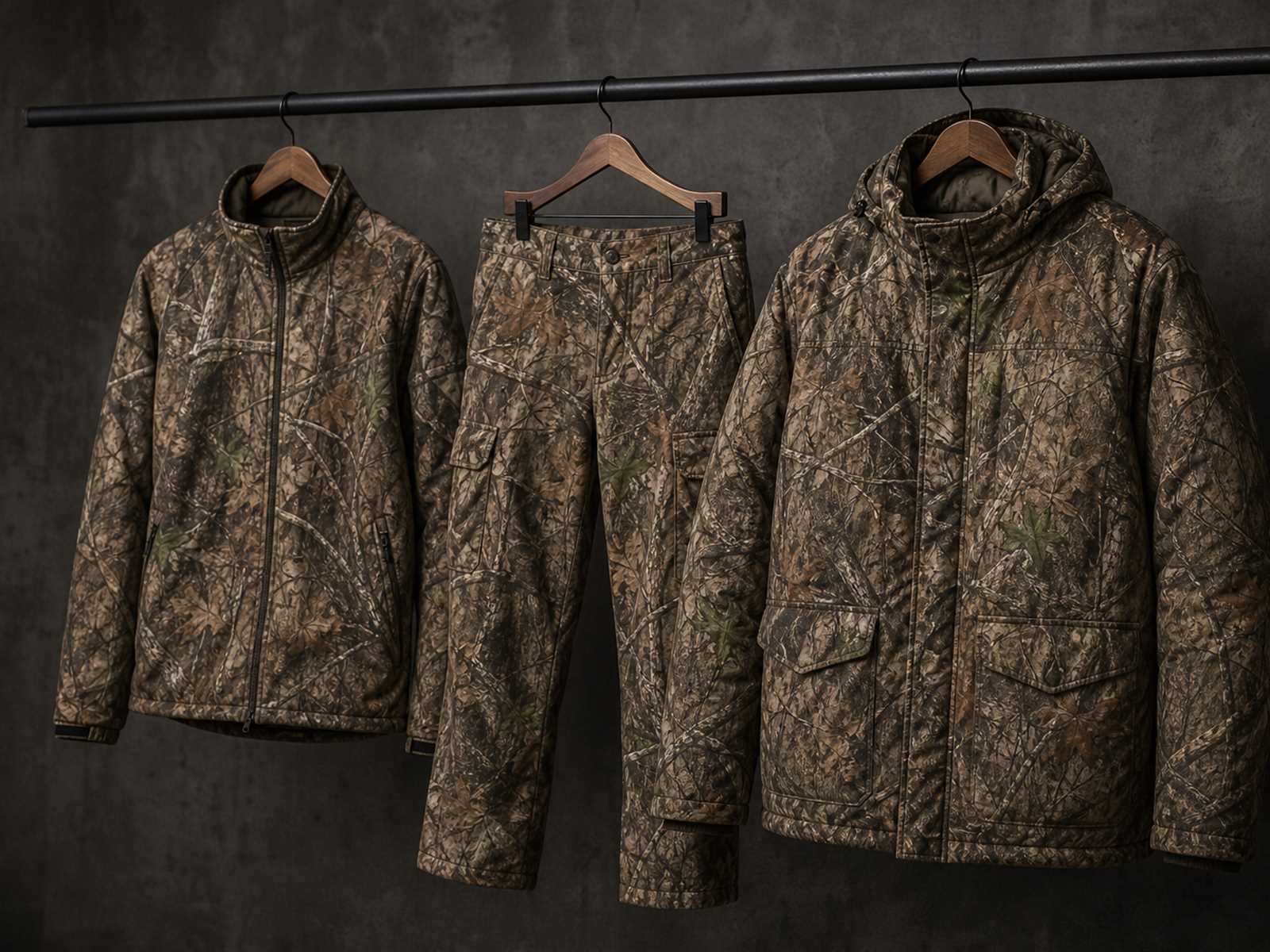
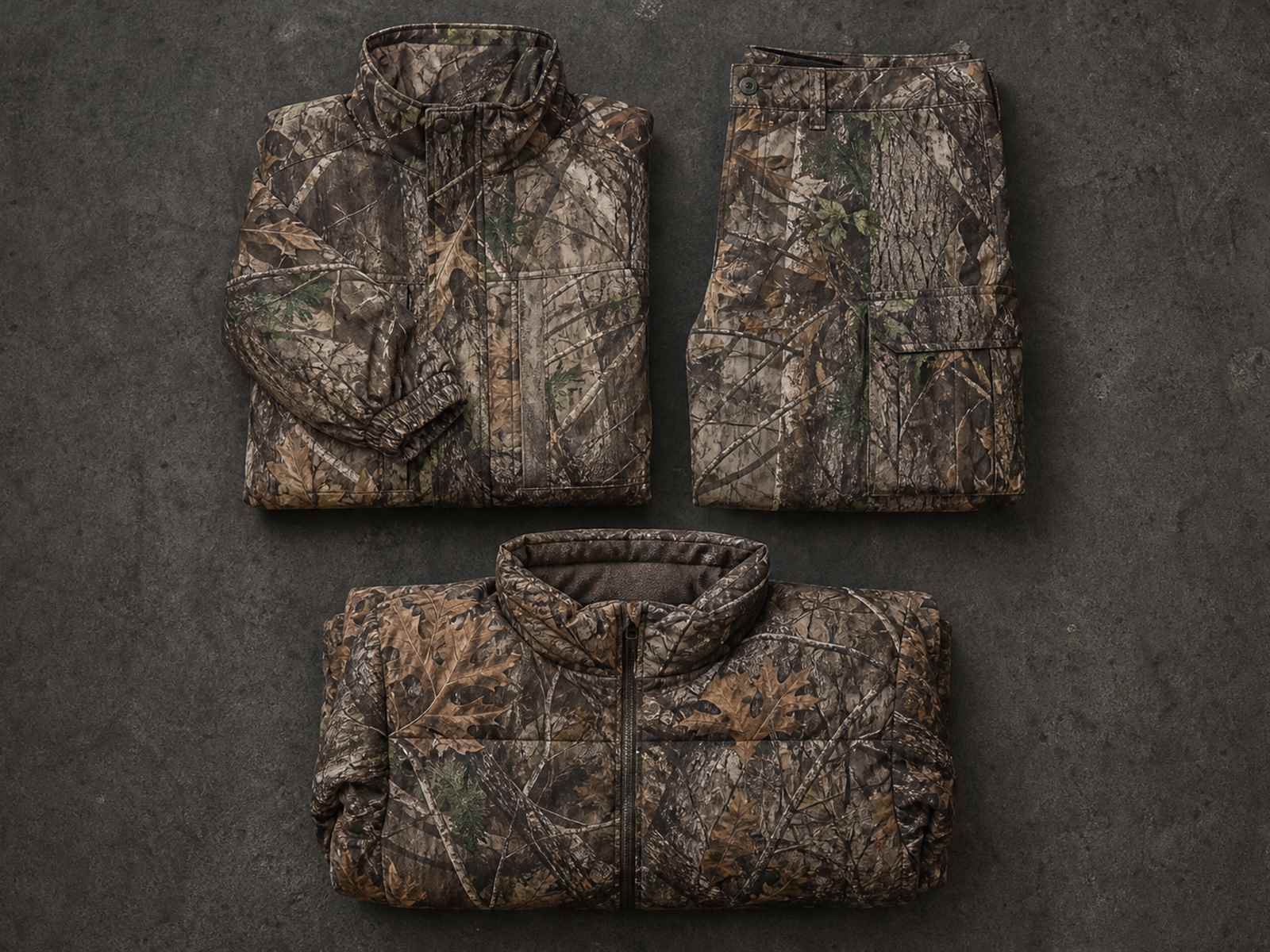
Custom camouflage hunting jacket and pants with quiet shell fabric manufactured for OEM buyers
Primary keyword
hunting camouflage clothing manufacturer
Climate focus
Cool / Variable / All Season Layers · Cool / Wet / Rough Terrain · Cold / Static Sit / Late Season
Development input
Tech pack · Reference sample · Sketch · Photo
Hunting & Outdoor Camouflage ClothingHunting & Outdoor Camouflage ClothingHunting & Outdoor Camouflage ClothingHunting & Outdoor Camouflage Clothing

Buyers

Who buys hunting & outdoor camouflage clothing?

Hunting & Outdoor Camouflage Clothing is specified by organisations rather than bought as a single garment, so a quotation has to satisfy all 6 buyer profiles listed below.

Hunting & Outdoor Brands

A production partner who can hold a camouflage print standard and a quiet shell fabric across seasons, so that a range addition matches garments already in the market.

Outdoor Retail Chains & Buying Groups

Volume stock in stable size sets against a written specification, with packaging that can go straight to the shelf or the floor.

Hunting Camo Print Owners & Licensors

Their own artwork applied to garment programs at a consistent repeat scale, with print approval controlled before bulk cutting.

Uniform Distributors & Wholesalers

Camouflage and muted colour ranges sold next to their tactical lines, sharing a size chart so customers order one system.

Private Label & Direct-to-Consumer Brands

A developed product they can brand entirely as their own, with labels, hangtags and packaging produced to their artwork.

Procurement Companies & Importers

Material and construction transparency, pre-production sample approval and inspection documentation issued before shipment.

Types

Hunting & Outdoor Camouflage Clothing types

The same category name covers very different garments depending on climate and wear pattern. 3 types of Hunting & Outdoor Camouflage Clothing are covered here, and the type is chosen before the fabric.

Cool / Variable / All Season Layers

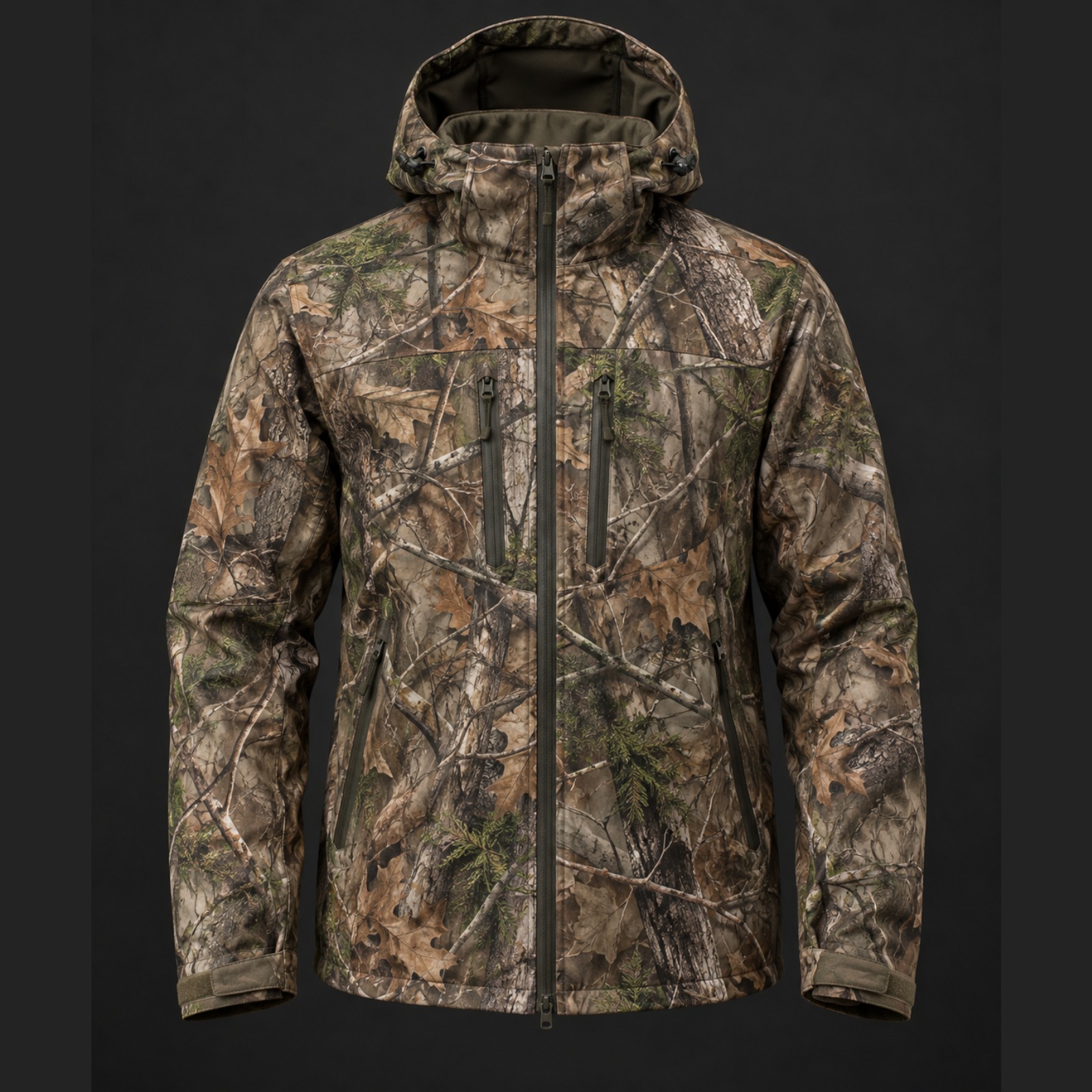
Hunting Camo Jacket

The jacket carries the print, the quiet shell and most of the feature value. Design is dominated by two questions: how loud the fabric is when it moves, and how the garment handles light rain without becoming a stiff, noisy shell. Insulation, hood design and pocket layout are then layered onto that decision, and each addition should be tested against whether it helps the wearer stay still and unheard.

  • Quiet brushed or soft shell surface
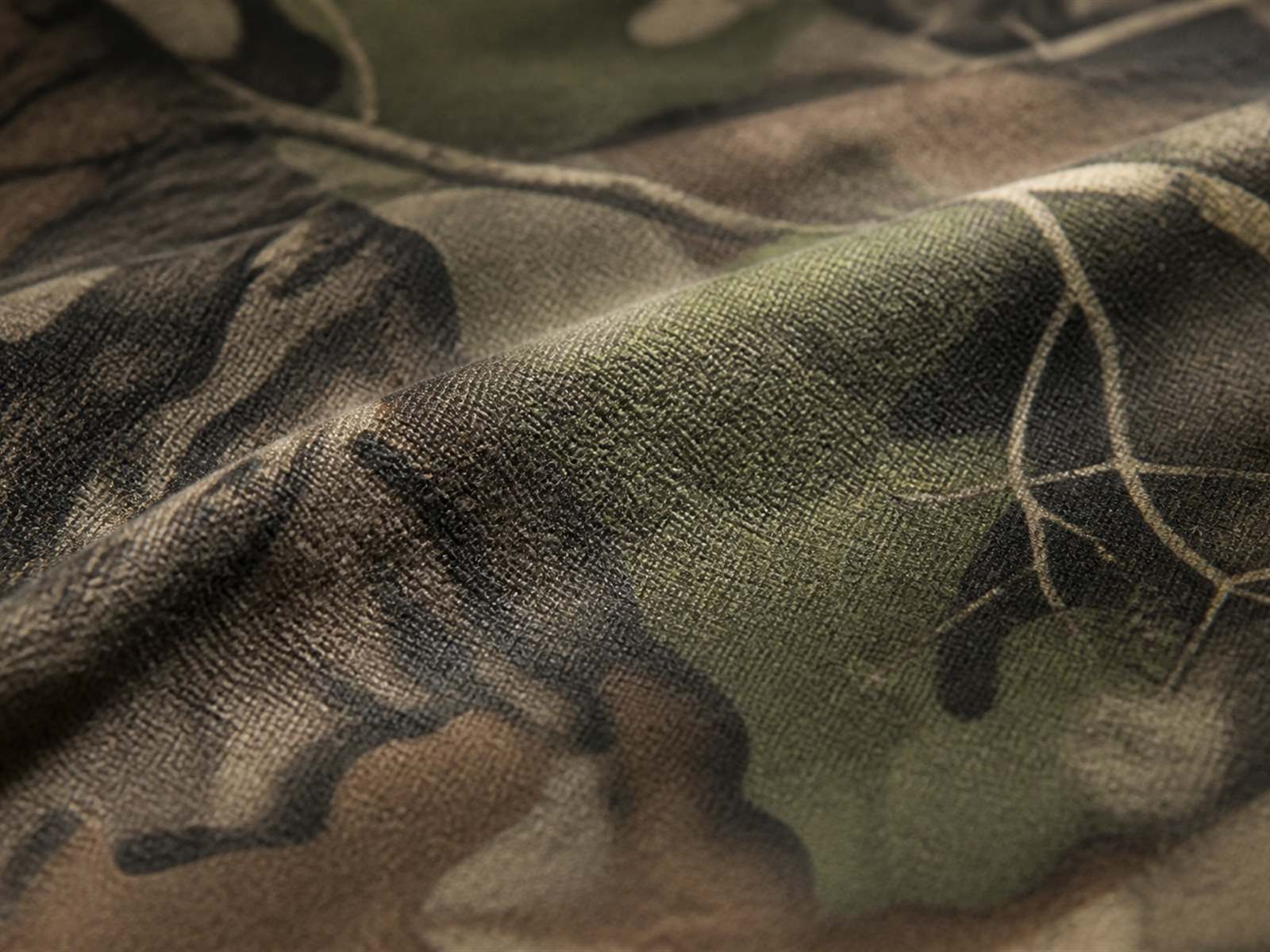
  • Camouflage print with controlled repeat scale
  • Insulation options from unlined to full
  • Hood with face and ear coverage
  • Low-profile pockets to avoid noise and bulk
Cool / Wet / Rough Terrain

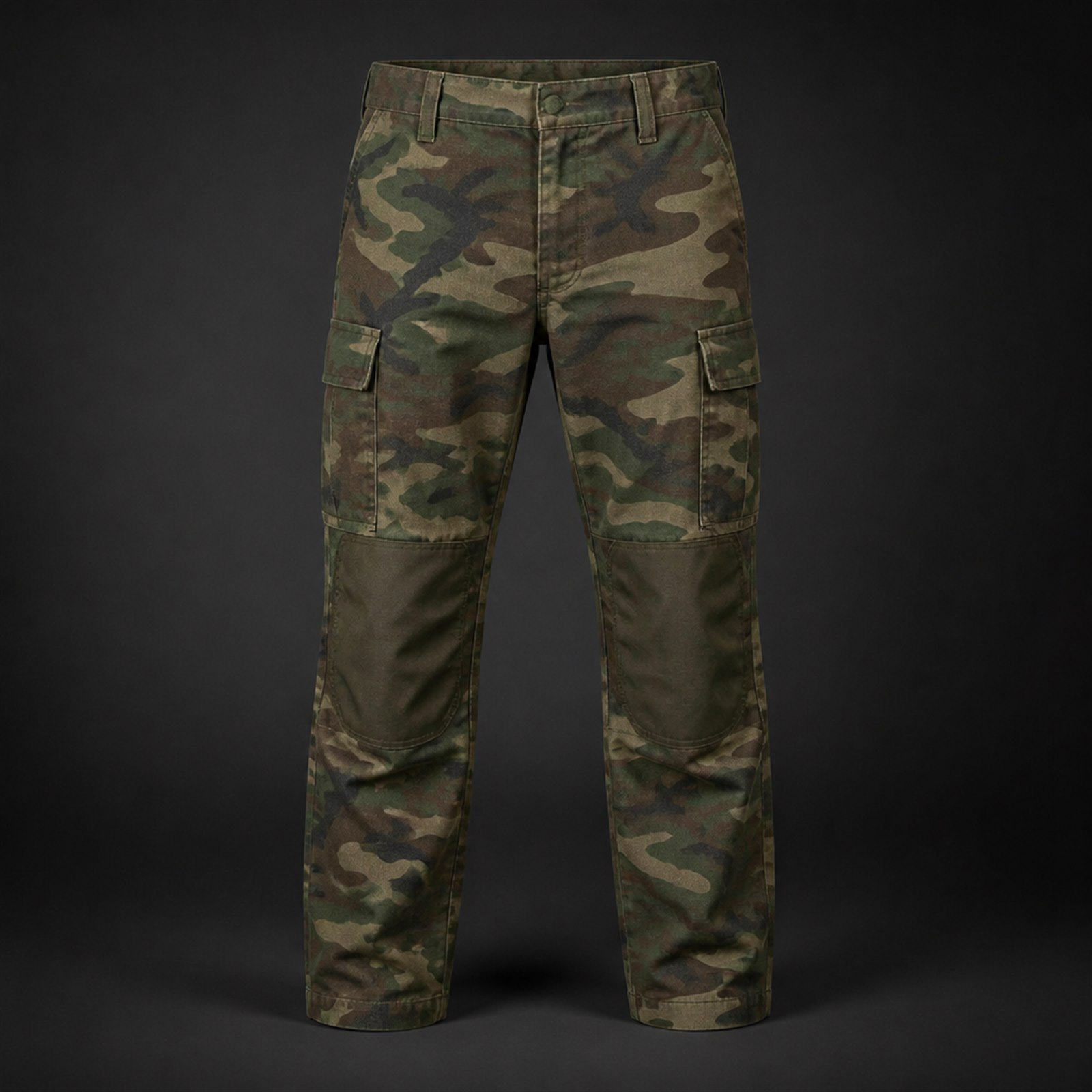
Hunting Camo Pants

Pants take more abrasion than any other item in a hunting range. Movement through brush and repeated kneeling wear the knee, seat and lower leg first, and the fabric also needs enough stretch to allow climbing and stepping over obstacles. Water resistance at the lower leg is often more valuable than overall waterproofing, because wet fabric at the boot line is what makes a pant uncomfortable for the rest of the day.

  • Stretch or mechanical stretch woven fabric
  • Reinforced knee and seat panels
  • Water-resistant lower leg treatment
  • Quiet fabric without a crisp finish
  • Adjustable waist and hem for layering and boots

Cold / Static Sit / Late Season

Insulated Hunting Set for Static Use

Static hunting, whether in a blind or on a stand, demands warmth with a quiet outer surface, and that combination is harder to achieve than it sounds. Insulation adds warmth but also adds bulk, which reduces packability and can make the garment noisy where panels rub together. The design problem is placing insulation where it is needed while keeping the areas that rub against each other quiet and low-bulk.

  • Insulated body with quieter outer shell
  • Reduced insulation at the sleeves for movement
  • Fleece-lined collar and pocket bags
  • Silent closures instead of hard hardware
  • Ventilation so the wearer can manage heat on the walk in

Engineering

Construction, part by part

8 construction decisions define Hunting & Outdoor Camouflage Clothing, and each row below is one decision you control at specification stage.

Hood

  • Fixed hood with face coverage
  • Detachable hood
  • Roll-away hood
  • Hood with ear flap and face mask
  • No hood (collar-only builds)

Hood design is a concealment decision as much as a weather one. A hood that shifts when the wearer turns their head creates both noise and a silhouette break, while a hood that covers too much reduces peripheral awareness. Face coverage options change the pattern substantially and must be agreed early.

Collar

  • Stand collar with quiet closure
  • Fleece-lined stand collar
  • Fold-down collar
  • Collar with concealed face mask pocket
  • Zip-through collar with chin guard

The collar is where hard hardware becomes audible. Hook and loop is loud when opened, so magnetic, snap or covered closures are often preferred even though they add cost and require testing. Fleece lining improves comfort against the neck but holds moisture longer than a smooth lining.

Front Closure

  • Zip with internal storm flap
  • Zip with external storm flap
  • Silent snap closure with placket
  • Two-way zip
  • Covered magnetic closure

The closure has to stay quiet when opened slowly and stay sealed when the wearer is stationary in wind. These two requirements pull against each other, and the answer usually depends on whether the wearer will open the jacket while in position or only during movement.

Sleeve & Cuff

  • Articulated sleeve for reach
  • Hook and loop adjustable cuff
  • Elasticated cuff
  • Inner storm cuff
  • Reinforced forearm for brush and climbing

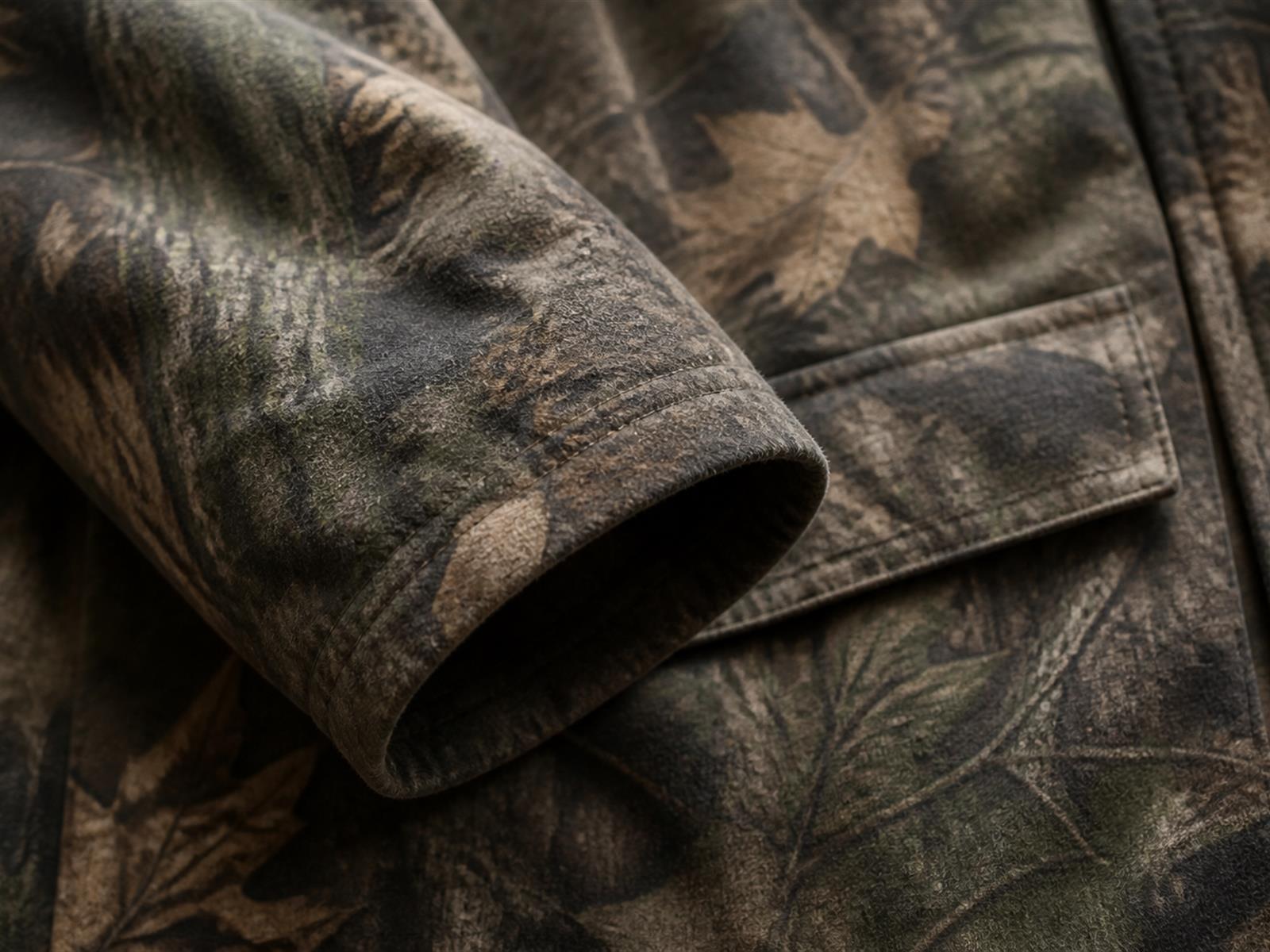
The sleeve is the noisiest part of a garment against vegetation and equipment, and it is also where articulation matters most for a bow or rifle position. Reinforcement at the forearm improves durability but stiffens the sleeve, so it should stop short of the elbow where possible.

Pockets

  • Zippered chest pocket
  • Low-profile hand warmer pockets
  • Cargo thigh pockets with quiet closures
  • Internal security pocket
  • Game bag or rear pocket

Pocket placement must be checked against the way the garment is used: sitting, kneeling, carrying a pack or a sling. Pockets that rub against each other, or that sit under a sling, add noise and reduce comfort where the wearer is trying to stay still.

Waist & Hem

  • Elasticated waist with belt loops
  • Adjustable waist tabs
  • Internal drawcord hem
  • Boot-compatible hem with cuff guard
  • Straight hem with no cord

Hem treatment on a hunting pant is usually about boots and layering rather than styling. An adjustable hem keeps the fabric clear of wet ground, while an internal cord avoids the snagging and noise that an external cord creates in brush.

Seat & Knee Reinforcement

  • Double-layer knee panel
  • Internal knee pad pocket
  • Reinforced seat panel
  • Abrasion-resistant lower leg guard
  • Bar-tacked stress points only

Brush, rock and repeated kneeling destroy the knee and seat long before the seams fail. Reinforcement there is the highest-value durability decision in a hunting range, but overlays should be kept quiet and flexible so that the garment does not become stiff exactly where the wearer bends.

Lining & Quiet Construction

  • Mesh lining
  • Taffeta lining
  • Brushed tricot lining
  • Fleece lining
  • Bonded quiet face fabric
  • Seam and edge treatment to reduce rustle

Quietness comes from the fabric surface, the lining, and how panels are joined and finished, not from a single component. Bonded constructions and brushed backings reduce noise at some cost to breathability and drying speed, and every added treatment makes the garment heavier to carry.

Available fabrics

Material options by garment area

Shell

SoftshellWater resistant fabricCotton ripstopPoly cotton ripstopStretch ripstopBrushed quiet tricot shellWind resistant fabric

Shell selection is a direct trade between quietness, abrasion resistance, water resistance and drying speed. Brushed and bonded fabrics are the quietest but are generally less abrasion-resistant and slower to dry; crisp ripstop is stronger and faster to dry but audible in brush. The intended hunting method should decide which cost is acceptable.

Lining & Insulation

Mesh liningTaffeta liningFleece liningBrushed tricot liningCold weather insulation materialUnlined single layer

Insulation choice decides warmth, bulk and how quietly the garment moves on the wearer. Body-only insulation keeps the sleeves mobile and reduces noise at the arms, but leaves the wearer dependent on layering for arm warmth.

Reinforcement & Trim

Abrasion-resistant woven overlayRipstop knee and seat panelsLower leg guard panelEdge binding at cuffs and hemsQuiet closures in place of hard hardware

Every reinforcement and trim item is also a potential noise source. Overlays should be selected for flexibility as well as strength, and hardware should be tested by opening and closing it slowly rather than quickly, because that is the condition the wearer is trying to achieve.

Customization

What can be customized

14 specification lines are available for Hunting & Outdoor Camouflage Clothing, and where an option changes cost, weight or durability the consequence is stated next to it.

Fabric

Shell familyLining and insulation familyReinforcement optionsBuyer-specified composition

Camouflage Pattern

Buyer artworkWoodland styleDesert styleDigital styleCustom seasonal pattern

Print Scale & Repeat

Buyer-specified repeat scaleContinuous across seamsPanel-based placementBuyer print standard approval

Color

Muted solid colourwaysBuyer Pantone targetsBuyer lab dip approval

Visibility

Fully concealed configurationReversible with high-visibility sideRemovable high-visibility panelBlaze or safety accent placement

Hood

Fixed with face coverageDetachableRoll-awayEar flap and face mask optionNone

Closure

Zip with storm flapSilent snap placketTwo-way zipCovered magnetic closure

Zipper

Buyer-specified brand or tape widthQuiet-operation zipStandard coil zipGlove-friendly puller

Cuff

Hook and loopElasticatedInner storm cuffPlain hemmed

Pocket

ChestHand warmerCargo thighInternal securityGame bag or rear pocket

Insulation

UnlinedLight insulationBody-only insulationFull insulationRemovable liner

Reinforcement

Knee panelsSeat panelLower leg guardForearm panelsStress point bartacks

Logo

Woven labelPrinted labelRubber patchEmbroideryHeat transfer

Label & Packaging

Main labelSize and care labelCountry of origin labelHangtag and header cardPrinted poly bag or custom box

Sizing

Size development

Hunting clothing is worn over layers that change through the season, which makes size development more complicated than a single-season garment. Before a size set is built we need the buyer's size range, the measurements of a reference garment, and a statement of the layering the garment must cover, for example a base layer in early season and a mid-layer plus insulation late season. A size set is then produced and checked across the range for chest, shoulder, sleeve length, back length, waist, hip, rise and inseam, plus the thigh and knee opening on pants where kneeling and climbing matter. Where a pant is designed to be worn over boots or a base layer, hem opening and lower leg volume are reviewed specifically. Tolerances are agreed in writing before bulk so that inline and final inspection measure the same numbers the buyer approved.

How size development works

Branding

Private label

Private label is central in this category because the brand and the camouflage pattern together carry the product. Main label, size label, care label and country of origin label are produced to the buyer's artwork and content requirements. Branding can be applied as woven label, printed label, rubber patch, embroidery or heat transfer. Where the buyer owns the camouflage artwork, the print standard, repeat scale and colour targets are approved before bulk and kept on file so that a later order can be printed to the same standard. Packaging can be a plain poly bag or a printed poly bag with hangtag, header card and custom box produced to the buyer's artwork. Everything visible is confirmed on the pre-production sample before bulk begins.

Customization capability

Development

Sampling process

Sampling for Hunting & Outdoor Camouflage Clothing runs in 8 stages, each one removing a specific risk before the next stage commits cost.

01

Requirement review

We review the buyer's tech pack, reference garment, photograph or sketch and list every open specification before any material is cut.

02

Method and climate definition

We record how the garment will be used, for example static hunting, active stalking or general outdoor wear, and in which season and climate, because quietness, insulation and water resistance are prioritised differently in each case.

03

Material selection

Shell, lining and reinforcement fabrics are proposed against that use, with alternatives where the quietness, abrasion resistance or drying speed requirement is not yet fixed.

04

Camouflage print standard

Where the buyer owns the artwork, the print standard, repeat scale and colour targets are set and a print strike is approved before bulk fabric is ordered.

05

Pattern development

The pattern is developed or adapted to the buyer's reference, including sleeve articulation, hood and face coverage, knee shaping and pocket placement.

06

Prototype

A first sample is produced in the proposed materials so the buyer can assess fit over the intended layers, material hand and how the fabric sounds and drapes in use.

07

Revision and size set

Buyer comments are consolidated into one revision round, and the full size range is produced for measurement confirmation across all sizes.

08

Pre-production sample

The approved construction, materials, print standard and labelling are locked in a pre-production sample that becomes the bulk standard.

Production

Bulk manufacturing

Bulk production of Hunting & Outdoor Camouflage Clothing runs in 8 stages, which is where an approved specification is either held or lost.

01

Fabric and trim approval

Bulk shell fabric, lining, insulation, zips, thread and labels are approved against the pre-production standard before cutting.

02

Print lot verification

Printed fabric lots are checked against the approved print standard for shade, repeat scale and alignment before cutting, because print lots received at different times rarely match by default.

03

Bulk cutting

Cutting is done against the approved pattern with markers controlled for shade, print placement and, where the design requires it, continuity of the camouflage repeat across seams.

04

Panel preparation

Reinforcement panels, pocket bags, hood sections and linings are prepared and checked before assembly rather than during it.

05

Assembly

Line assembly follows the approved construction sequence, with bartacks and reinforcement at the stress points defined in the specification.

06

Inline quality control

Garments are inspected during assembly so a fault is corrected on the line instead of being found after packing.

07

Finishing and hardware check

Thread trimming, function testing of every zip, cord and closure, and pressing are completed before final inspection.

08

Final inspection and packing

Measurement, construction, print placement and packing inspection are completed against the agreed standard and documented for the buyer.

Quality Control

Quality control for this category

Inspection of Hunting & Outdoor Camouflage Clothing is measured against an agreed standard, and the 7 checks below are listed with what each one is measured against.

01

Incoming fabric inspection

Fabric is checked on receipt for shade, width, weight, print scale, repeat alignment and defects before it enters production.

02

Accessory inspection

Zips, closures, cord, hook and loop and labels are checked for function, noise behaviour and colour against the approved standard.

03

Pre-production approval

The pre-production sample is approved by the buyer and becomes the reference standard for bulk.

04

Inline inspection

Work in progress is inspected at defined points, including closure assembly, hood attachment, reinforcement placement and lining insertion.

05

Measurement inspection

Critical measurements are measured against the approved size set with the tolerances agreed in writing.

06

Construction, print and symmetry inspection

Stitching, seam integrity, reinforcement, closure function and left-right symmetry are checked, and print placement is verified against the approved standard.

07

Final and packing inspection

Finished goods are inspected before packing, and labels, folding, bagging and carton marking are checked against the packing instruction.

Choosing a Hunting & Outdoor Camouflage Clothing manufacturer

How to choose a hunting & outdoor camouflage clothing manufacturer

The 6 questions buyers ask about Hunting & Outdoor Camouflage Clothing before committing to a first order.

Test the fabric for noise, not only for feel

Every supplier will describe a shell as quiet. The useful test is to fold the fabric against itself, rub a sleeve across a shoulder panel and listen. Fasteners should be opened and closed slowly, because that is how a hunter opens a jacket in position. Ask to see or feel the actual bulk fabric, not a swatch from a previous season, since finish and hand vary between lots and mills.

Decide where water resistance is needed and where it is not

Waterproofing the whole garment usually means a stiffer, noisier fabric and reduced breathability. Most hunting ranges are better served by a shell that resists light rain and dries quickly, with real rain protection concentrated where the wearer meets water, such as the lower leg and the shoulders. Making that decision deliberately avoids paying for protection in places it does not help.

Set the visibility requirement before the pattern is made

Where local requirements call for a visibility element, the placement has to be designed in from the start. Reversible construction, a removable high-visibility panel or a bounded accent area all change the pattern and the fabric order. Retrofitting visibility to a finished design compromises both concealment and the safety intent.

Ask how the print standard is controlled between orders

A camouflage print that drifts in shade or repeat scale is immediately obvious to a customer who owns the earlier garment. Ask how the print standard is stored, how incoming printed lots are checked, and what happens if a lot does not match. This is what makes a second season look like the first.

Fit the sample over the layers the season demands

The same hunter wears the jacket over a base layer in early season and over insulation later. Send the actual layering combination or give its thickness, and confirm the hem and cuff closures work with the boots and gloves in the range. Layering errors are far cheaper to fix on a sample than on a sold order.

Confirm that reinforcement does not fight movement

Knee, seat and forearm reinforcement is where a hunting garment earns its service life, but stiff overlays in the wrong place make kneeling and climbing harder. Ask where the reinforcement is placed, how far it extends, and whether it was checked in a bent-knee position rather than on a flat table.

Products

Hunting & Outdoor Camouflage Clothing products

Each product in Hunting & Outdoor Camouflage Clothing is a developed specification with its own material options, construction detail and customization map.

Hunting & Outdoor Camouflage Clothing

Hunting Camo Jacket

A hunting jacket is judged by two properties that pull against each other: how quietly it moves through brush, and how well it survives that brush.

TemperateColdWet / Rainy
View product

Hunting & Outdoor Camouflage Clothing

Hunting Camo Pants

Hunting pants fail in predictable places, and they fail for predictable reasons.

TemperateColdWet / Rainy
View product

FAQ

Hunting & Outdoor Camouflage Clothing FAQ

Can you print our own camouflage pattern onto a jacket and pant range?

Yes. Buyer artwork can be developed into a print standard with agreed colour targets and repeat scale, and a print strike is approved before bulk fabric is ordered. The standard is kept on file so that later orders and additional styles can be printed to the same reference.

How do you balance quietness with durability?

They pull against each other. Brushed and bonded faces are the quietest but generally less abrasion-resistant, while crisp ripstop is stronger and faster to dry but audible in brush. The usual answer is a quiet main shell combined with reinforcement at the contact zones, so the garment stays silent where the hunter moves and stays strong where it meets the ground and vegetation.

Can the same garment cover a wide temperature range?

Only with a layering system. A lightly lined shell covers a wide band if the wearer adds or removes mid-layers, but a single garment cannot be both packable in the heat and warm in late-season cold without compromise. Many ranges split this into an unlined or lightly lined shell and an insulated set, sharing the same print and pattern family.

Do you offer a high-visibility or reversible option?

Yes. Reversible construction, removable high-visibility panels and bounded accent areas can all be specified. The construction and the visibility requirement need to be decided together with the pattern, because the placement affects material consumption and the way the garment assembles.

Which fabric do you recommend for wet hunting conditions?

Start from how long the wearer will be out and how much movement is involved. A water-resistant, quick-drying shell with protection concentrated at the shoulders and lower leg suits most active wet-weather hunting, while sustained rain in a static position argues for a waterproof shell and an acceptance of the extra stiffness and noise. Fabric specification is confirmed per programme against your stated conditions.

What information do you need to quote a hunting clothing programme?

Product type, target quantity, shell and insulation direction, camouflage artwork or print reference, hood and pocket requirements, size range, labelling and packaging, and the hunting method and climate the range is built for. A reference sample, photograph or tech pack helps most. Where a figure such as MOQ or lead time has not been confirmed with you, we will state that rather than assume one.

Request a Manufacturing Assessment

Send us your tech pack, reference sample or product idea. We review your requirement, recommend materials and construction, and come back with a development plan you can act on.